Journal of Energy Security

Text size
  • Increase font size
  • Default font size
  • Decrease font size
Home December 2008 Issue

December 2008 Issue

From the Editor

During the recent Presidential elections much was made about how the US economy could drill its way to a more secure energy future. December’s issue of the Journal of Energy Security throws a damper on this notion with some clear-headed if not sobering analysis of just how far US domestic oil and gas drilling can really take us. While this stark, apolitical analysis is not music to the ears it may be just what the doctor ordered to catalyze realistic political debate in the new Obama administration for arranging the hard policy choices needed for securing America’s energy future.

On August 4, 2007 a submarine planted a rust-proof Russian titanium flag on the bed of the Arctic sea-floor. As the Arctic ice melts, countries are competing for what is believed to be vast reserves of oil and natural gas hidden beneath this icy core. The big-boy on this block, Canada not Russia, must deal with competition over these resources and how it impacts on its own national security. Balancing domestic considerations over energy, the environment, and the rights of Canada’s Arctic indigenous peoples is but the tip of this melting iceberg in this first analysis of Canadian Arctic energy security from a Canadian intelligence perspective.

Remiss it would certainly be to ignore the implications of the global financial meltdown on energy markets and supply security. As the world’s largest non-OPEC oil producer, economic calamity is particularly egregious for Russian oil output and its stalled gas industry aka Gazprom. The stakes are high for import dependent European Union member states and others in Russia’s neighborhood. So here we take a look. And if this wasn’t enough, in October Russia, Iran and Qatar announced their intention to coordinate "gas policy." The Journal of Energy Security offers two views on this development from Ariel Cohen at Washington’s venerable Heritage Foundation and from Warren Wilczewski with the Carnegie Council for Ethics in International Affairs who believes the muscle behind a pending "Gas Troika" is but a lot of hot air. Finally, we are interested in your thoughts and suggestions for our coverage of global energy security issues. Letters to the editor are welcome and warmly encouraged.

editor@iags.org


Gas Exporting Countries Forum: The Russian-Iranian Gas Cartel

Consumers of natural gas may be on the verge of confronting something very big and ugly: a global gas cartel. What makes such a cartel dangerous to consumers beyond inflated prices is the fact that because natural gas delivery is fixed to infrastructure the fungible nature of oil transport simply is not there.  Terms like "ring-fencing", "price-gouging" and "foreign energy policy" spring to mind within the context of such a cartel's development.  Is this threat real?  If so, what can or should we do about it? 

Read more...

Canadian Arctic Energy Security

Of all the littoral Arctic states, Canada has its own deeply vested national security interests in how this region and its potentially vast energy resources are developed.  Caught between the geopolitical significance US and Russian interests place on the region, surging demand for new energy resources from China and India, and its own national priorities the Arctic could become a model for international cooperation or a landscape riddled with future conflict.

Read more...

The Big Gas Troika: A Lot of Hot Air

Are Russia, Iran and Qatar really capable of creating an operative "Big Gas Troika" with the power to set regional if not global prices for natural gas and LNG?  Parallels between OPEC and the nascent Organization of Gas Exporting Countries are undeniable.  But how are far do these similarites go and to what extent is cooperation limited by  competition between the world's major gas producers? 

Read more...

Can The United States Drill Its Way to Energy Security?

Can The United States Drill Its Way to Energy Security?

The United States is incapable of drilling its way to energy security.  If this is the case, then why was there so much banter given to "Drill-Baby-Drill!" during the recent US Presidential Elections?  Digging down into the real numbers behind the rhetoric gives new insight into just what oil and gas companies, the US economy and the US consumer are up against.  Here is a reality check we all might want to pay attention to.

Read more...
  • «
  •  Start 
  •  Prev 
  •  1 
  •  2 
  •  Next 
  •  End 
  • »
Page 1 of 2

Video

New Books

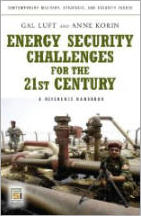
Energy Security Challenges for the 21st Century


"Remarkable collection spanning geopolitics, economy and technology. This timely and comprehensive volume is a one stop shop for anyone interested in one of the most important issues in international relations."
U.S. Senator Richard G. Lugar


"A small masterpiece -- right on the money both strategically and technically, witty, far-sighted, and barbeques a number of sacred cows. Absolutely do not miss this."
R. James Woolsey, Former CIA Director

"The book is going to become the Bible for everyone who is serious about energy and national security."
Robert C. McFarlane, Former U.S. National Security Advisor


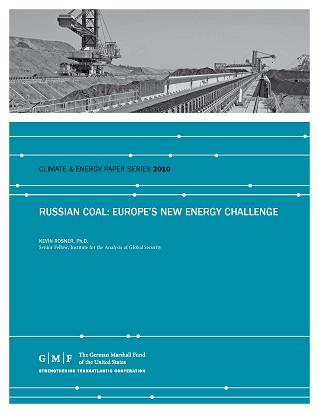
Russian Coal: Europe's New Energy Challenge

Quoted

Audio interview with Gal Luft, click to listen.
"Ending Offshore Oil Drilling: More Harm Than Good?," NPR, May 18, 2010


Gal Luft said the Iran-Pakistan gas pipeline could also "have profound implications for the geopolitics of energy in the 21st century and for the future of South Asia."
"Pakistan gas pipeline is Iran's lifeline ," UPI, March 19, 2010


"To be able to honour its gas export contracts, Russia has to turn to coal, said Kevin Rosner, senior fellow at the US Institute for the Analysis of Global Security. Rosner presented his research, entitled 'Russian coal: Europe's new energy challenge' and sponsored by the German Marshall Fund of the United States, at a public event hosted by the Friedrich Ebert Foundation."
"West worries about Russia turning to coal," EurActiv, March 10, 2010


Gal Luft, executive director of the Institute for the Analysis of Global Security, said Iran has dropped its reliance on gasoline imports from 40 percent to 25 percent [...] "There is a lot of hype about gasoline sanctions, but they are not going to be very effective," Luft said. "We've missed the boat on this one."
"Oil, Ideology Keep China From Joining Push Against Iran," The Washington Post, September 30, 2009


"When the war really began, the Saudis did not protect their border and thousands of jihadis went across. The Saudis preferred to sit on their hands and allowed this influx into Iraq," Gal Luft said. "Both Iran and Saudi Arabia were concerned that Iraqi oil would eat into their [Opec production] quotas. They have made a fortune from the lack of Iraqi production."
"Basra's failed oil bonanza," The Guardian, April 15, 2009

"The countries involved in making Nabucco happen and the EU should support the project and not be intimidated by Russia," said Kevin Rosner, senior fellow at the independent Institute for the Analysis of Global Security in Washington. "Russia, by creating the impression that the entire Caucasus was now so unstable is exactly what it intended to do in order to destroy Nabucco."
"Georgia crisis could thwart EU project to bypass Russia for natural gas," International Herald Tribune, August 28, 2008